
Reeves Projected and Actual Dates
A projected date is a calculation, not proof that a person left custody. TDCJ defines Projected Release Date as the date its Classification and Records Office expects release from incarceration if parole does not occur sooner. Depending on the case, it may point to mandatory supervision or the full discharge or maximum-expiration date. Offense date, offense type, sentence, eligibility, credits, and Board action all matter.
An actual release date records an event that already happened. At Reeves County Jail, the official daily PDF may mark a row RELEASED and list the date and time. In BOP Locator, a past date with Released or no institution means BOP custody ended. Each label is system-specific. None, by itself, proves the end of every detainer, warrant, transfer, or supervision term.
Find a Reeves Release Date
First decide whether the person is a county detainee, county-sentenced inmate, state prisoner, federal prisoner, or immigration detainee. A local arrest does not mean the person entered TDCJ. A disappearance from the Reeves roster is only a clue.
- Open the Reeves County jail page and its current daily PDF.
- Check custody status, booking time, and any release timestamp.
- Identify the misdemeanor, felony, or federal court.
- For a TDCJ transfer, search by exact name, TDCJ number, or SID.
- Confirm a future date by email or telephone before making plans.
The Reeves County Clerk handles misdemeanor records. The District Clerk and 143rd District Court handle felony cases. Ask for the docket, judgment, sentence, time-credit terms, bond order, or release order. Court records explain legal authority, while the custodian records the physical exit.
TDCJ Reeves Date Search
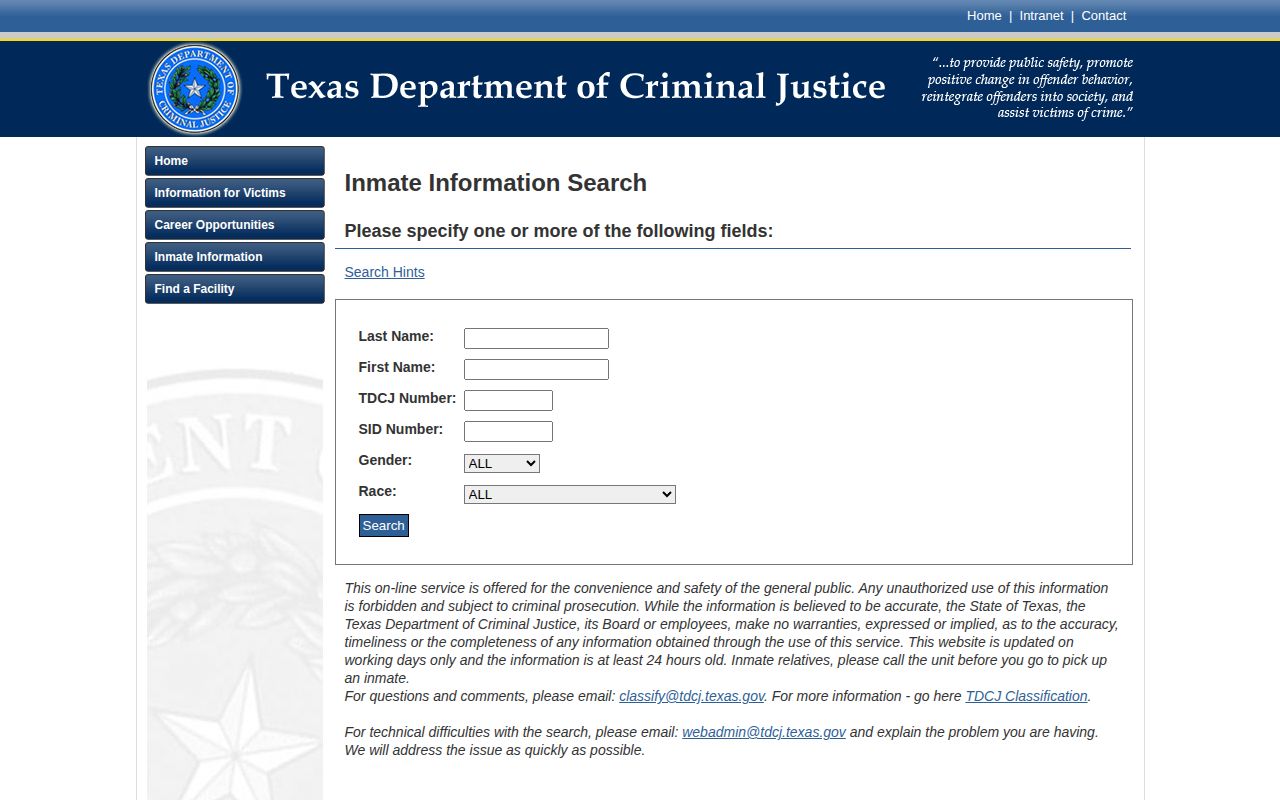
The TDCJ Online Inmate Search accepts an exact last name with at least a first initial, a TDCJ number, or a SID. It includes only people currently incarcerated in a TDCJ facility. The service updates on working days, and TDCJ warns that data are at least 24 hours old.
A current detail may show location, offenses, and Projected Release Date. It is not a released-offender archive. Once physical release occurs, a person normally drops out. A no-result cannot confirm release and may reflect spelling, delay, or another custodian.
The Reeves County jail and TDCJ systems answer different questions. Someone who bonds out locally may never have a TDCJ record. A transfer from the jail to a state unit is a Reeves release event but continued state incarceration.
The official TDCJ search page illustrates the current-only form and its limits:
Reeves Historical Date Channels
If the live record is gone or unclear, email pia@tdcj.texas.gov. Provide the full name and seven-digit TDCJ number. If that number is unknown, give the exact date of birth; if the birth date is unknown, give approximate age and county of conviction. Put the person's name in the subject and request specific existing information.
TDCJ lists the TDCJ number, location, conviction offense, prior incarceration by offense, county, and court, current incarceration facts, and projected release date as available information. The email service is free. It does not provide inmate photos or Social Security numbers.
Telephone service is available Monday through Friday from 8 a.m. to 5 p.m. The general inmate locator numbers are 936-295-6371 and 800-535-0283. Before a parole vote, use 844-512-0461. After approval, TDCJ directs release-status questions to the Parole Division at 512-406-5202. Have a TDCJ or SID number, or exact date of birth.
Texas Good Time for Reeves
Texas Government Code Chapter 498, including section 498.003, governs good-conduct time in state custody. Good time is a classification and release-calculation factor. It is not a simple promise that a fixed number of days comes off every sentence. Credits may affect eligibility or a projected date, and they may be lost through the disciplinary process.
Parole eligibility is offense, date, and sentence specific under section 508.145. Mandatory-supervision exclusions and discretionary review appear in section 508.149. Some formulas combine calendar time and good time to reach one-quarter of a sentence or fifteen years, whichever is less. Specified serious offenses can require actual calendar time, often one-half of the sentence or thirty years, with special rules for some offenses and life terms.
Texas does not have one blanket 85 percent rule. Applying such a percentage to every Reeves County case would be wrong. The current statute, judgment, TDCJ calculation, and Board decision control.
Why Reeves Release Dates Move
Several lawful events can change a date after it first appears. Read the current field and ask the responsible agency about a change rather than treating an old screenshot as final.
| Factor | Possible effect |
|---|---|
| Good-time award or loss | Changes the TDCJ calculation when the governing rules allow it. |
| Parole decision | May permit earlier conditional release or leave a later date in place. |
| Mandatory-supervision decision | Eligibility and Board discretion can alter the projected target. |
| Court order or corrected judgment | Can change sentence terms, credit, or legal authority. |
| Detainer or warrant | May cause transfer to another custodian instead of community return. |
| Release audit or program | Certification and required completion can affect scheduling. |
TDCJ says a Scheduled Release Date and Scheduled Release Location may be posted after approval and required program work. Certification and auditing take time. The date can change even on the scheduled day.
Reeves County Jail Credit
County-jail sentence credit is separate from TDCJ good time. Do not apply the state-prison projection formula to a Reeves County Jail stay. The sentencing judgment, the Sheriff's actual time and credit computation, and controlling criminal procedure determine the local answer.
A pretrial detainee usually has no fixed release date. Release may depend on bond, a hearing, dismissal, plea, sentence, transfer, or another court order. A bond amount is not a scheduled exit. Processing and another agency's hold can also affect the physical event.
For a focused request, ask the Reeves Sheriff's records clerk for the booking and release sheet, admission and release timestamps, custody disposition, receiving agency, and transfer date. No sheriff-specific fee or guaranteed response time was verified, so clerk copy fees should not be borrowed for this request.
Texas Date Computation Quirk
For an eligible Texas case, Projected Release Date may represent a mandatory-supervision target. For another case, it may be the full discharge or maximum-expiration date. The difference turns on the offense date, statutory eligibility, the sentence, and the Board's decision.
A denial of discretionary mandatory supervision can move the projection to discharge. A later approval can move it earlier. That is the distinctive reason a Reeves County reader should not convert the displayed field into a fixed countdown.
Parole is also conditional release, not sentence completion. Discharge means the sentence or supervision obligation has ended. A person can be physically out of prison while still reporting to the TDCJ Parole Division.
Confirm Reeves Actual Release
For a pending state release, use TDCJ IVSS for confidential status notifications and confirm through TDCJ records. The separate county IVSS system concerns county custody and court events. The Reeves County VINE check guide explains the post-2025 portal split.
A focused confirmation request names the person, agency number, facility, and narrow date range. Ask for the actual release time, disposition code, release-order reference, and receiving agency when a transfer may have occurred. Existing records are the point of the request.
Federal dates require BOP Locator and the Western District of Texas docket. A past BOP date ends BOP custody, not federal supervised release or an ICE hold. ICE ODLS covers current detention and some releases within about 60 days. A Reeves jail row can say RELEASED even when the next event is an ICE transfer.
Use two positive records when possible: an agency release timestamp plus a court order, a TDCJ notice plus release confirmation, or a BOP released result plus the federal judgment. That pair is far stronger than roster absence.
Report cutoffs matter. The verified Reeves daily report was a calendar-day product generated after the covered day, not a live countdown. A state projection may update on a working-day cycle. Note the report date, generation time, and exact field label.
Approved parole can carry conditions, program completion, and a later certified release site. Denial can leave another review date or make discharge control. Mandatory supervision is a statutory release path for eligible cases, while parole is discretionary. Discharge means the sentence or supervision duty has ended.
Public Record Search
Sponsored Results